Single Factor Analysis and Orthogonal Optimization Design on Critical Penetration Velocity of Tungsten Alloy Long Rod Projectile

  • CHEN Jun , 1 ,
  • DU Zhonghua , 1, 2 ,
  • DU Chengxin 2 ,
  • WANG Meng 1 ,
  • WANG Jiangbo 2
Expand
  • 1 College of Equipment Engineering, Shenyang Ligong University, Shenyang 110158, Liaoning, China
  • 2 School of Mechanical Engineering, Nanjing University of Science and Technology, Nanjing 210094, Jiangsu, China

Received date: 2024-05-07

  Online published: 2025-07-09

Abstract

In order to study the law of influence of aspect ratio, angle, thickness of target plate and section shape of projectile on the critical penetration velocity of projectile penetrating the target plate, finite element simulation technology was used to carry out single factor analysis of different factors on the critical penetration velocity of tungsten alloy long rod projectile penetrating the armor steel. Through orthogonal optimization design, the range of simulation results was used. The minimum critical penetration velocity of tungsten alloy long rod projectile penetrating armor steel is determined by analyzing the influence factors. The results show that the ratio of length to diameter is negatively correlated with the critical penetration velocity, the thickness of the target plate and the angle of impact are positively correlated with the critical penetration velocity, and the cross-section shape of the projectile also has some influence on the critical penetration velocity. The main and secondary factors affecting the critical penetration velocity of the projectile are as follows: the ratio of the projectile to diameter, the thickness of the target plate, the angle of impact, and the shape of the projectile section. Using the range value obtained from the orthogonal optimization table, the optimal combination of factors is as follows: the ratio of the aspect to diameter is 40, the thickness of the target plate is 30 mm, the angle of impact is 0°, the section shape is square, and the minimum critical penetration velocity is 545 m/s. The simulation technology combined with orthogonal optimization to analyze the critical penetration velocity greatly simplifies the simulation times, and further studies on the influence of various factors on the critical penetration velocity can provide reference value for subsequent similar studies.

Cite this article

CHEN Jun , DU Zhonghua , DU Chengxin , WANG Meng , WANG Jiangbo . Single Factor Analysis and Orthogonal Optimization Design on Critical Penetration Velocity of Tungsten Alloy Long Rod Projectile[J]. Journal of Projectiles, Rockets, Missiles and Guidance, 2025 , 45(3) : 400 -406 . DOI: 10.15892/j.cnki.djzdxb.2025.03.019

0 引言

长杆穿甲弹作为攻击装甲目标的主要手段之一,已有众多学者进行研究[1-15],而临界穿透速度作为衡量是否击穿目标的重要指标,具有重要的研究意义。
临界穿透速度也称弹道极限速度(V50),通常表示在一定靶板厚度情况下,弹丸50%概率击穿靶板的临界速度。目前针对此类问题常见的研究方法为实验及仿真,对验模成功后的仿真模型,基于仿真计算结果,进一步分析总结并得出结论[1]
肖云凯等[3]详细讨论了长杆弹长径比、弹靶材料、弹体尺寸效应等对侵彻深度的影响。黛喜会等[16]通过钨柱侵彻40Cr装甲钢实验及仿真,研究了长径比与着靶姿态对极限穿透速度的影响。王奕鑫等[17]通过12.7 mm穿燃弹侵彻不同厚度靶板的试验,并结合仿真技术及理论计算得到不同靶板厚度对临界穿透速度影响。
Liu等[18]研究了不同Ti/Al3Ti靶板厚度对钨合金球型破片的临界穿透速度影响,得到了靶板面积密度对临界穿透速度的经验公式。余庆波等[19]研究了弹丸头部形状对刚性弹丸侵彻钢靶的临界穿透速度影响。王陆军[20]利用试验与仿真研究了不同弹丸头部形状、冲击角度对钛合金靶板的临界穿透速度影响。
目前针对临界穿透速度影响规律的因素相关研究主要集中于各因素单独与临界穿透速度的关系,较少涉及各因素耦合作用下对临界穿透速度影响研究。
文中通过数值模拟对长径比、着角、靶板厚度、弹丸截面形状对弹丸临界穿透速度影响进行单因素分析,利用正交设计方法结合数值仿真结果,研究各因素对临界穿透速度的影响,并给出最低临界穿透速度的最佳组合。

1 仿真设置

以LS-DYNA软件建立三维仿真模型[21],时间步长设置为0.9,选用cm-g-μs单位制,六面体网格尺寸为0.5 mm,弹靶接触设置为侵蚀接触。
93W钨合金弹芯与603装甲钢靶板材料均选用Johnson-Cook[22]本构模型和Gruneisen[23]状态方程表示,弹芯材料与603装甲钢材料破坏形式采用Johnson-Cook失效准则作为失效判据,仿真参数如表1所示。
表1 仿真参数

Table 1 Simulation parameters

Material ρ/(kg·m-3) E/GPa ν A/MPa B/MPa
93W alloy 17 600 320 0.33 1 000 1 770
7 800 210 0.22 950 660
Material N c M D1
603 armour
steel
0.12 0.008 1 0.5
0.232 0.008 2 1.03 0.8
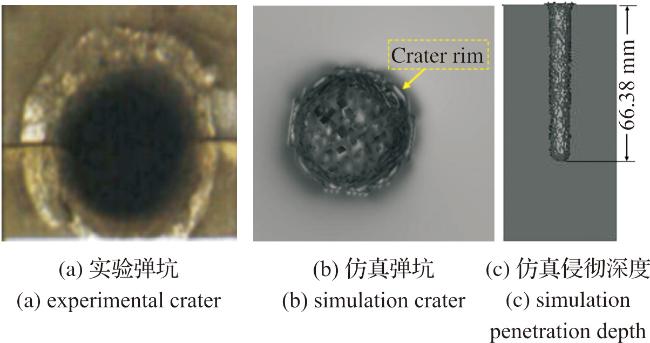
为了验证仿真模型的准确性,参考文献[6]的实验数据,选用钨合金长杆弹长径比8,弹丸直径8 mm,截面形状为圆形,弹丸侵彻速度1 615 m/s,仿真结果与实验结果如图1所示。
图1 对照图

Fig.1 Comparative diagram

图1所示,仿真所得弹坑边缘形状与实验相吻合;仿真侵彻深度66.38 mm,与实验得到的侵彻深度68 mm接近,误差仅为2.4%,验证了仿真模型的合理性。以上述仿真参数为源参数进行后续仿真分析。设置多组弹丸初始速度V0,当弹丸贯穿靶板后,记录靶后弹丸速度Vrem,参考六弹道实验法,进行多组仿真,将最大嵌入速度Vi-max与最小穿透速度Vp-min平均值作为临界穿透速度Vcri

2 单因素分析

2.1 长径比对临界穿透速度的影响

靶板厚度设置为30 mm,为保证弹体质量的一致性,三维弹体重量均保持一致,长径比L/D分别设置为5,10,20,40的钨合金长杆弹,其余参数保持源参数设置。
将不同长径比工况下得到的最大嵌入速度与最小贯穿速度绘制成表,如表2所示。
表2 长径比工况表

Table 2 Aspect ratio working conditions table

Condition L/D Vi-max/
(m/s)
Vp-min/
(m/s)
Vrem/
(m/s)
V50/
(m/s)
1 5 887.5 900 150 893.7
2 10 765.5 775 317 770.2
3 20 650 675.5 314 662.7
4 40 550 565.5 178 557.7
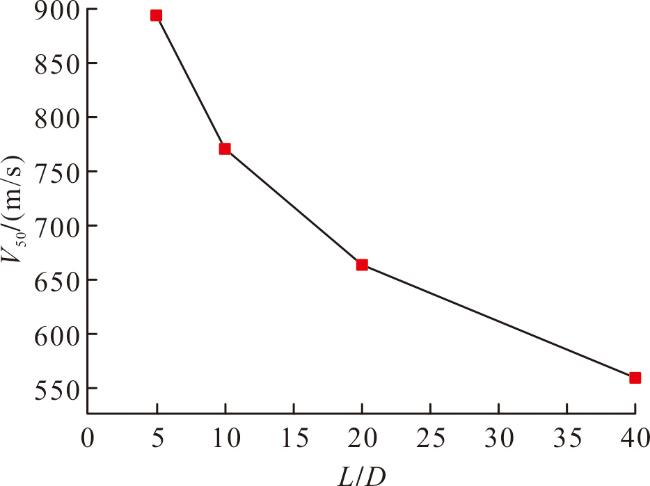
将上述各工况仿真得到的临界穿透速度V50绘制成曲线,如图2所示。
图2 L/D-V50曲线

Fig.2 Curve of L/D-V50

表2图2可知,在弹丸着角、靶板厚度、截面形状不变的情况下,长径比越大,弹丸临界穿透速度越小,随着弹丸侵彻靶板,侵彻过程中不断发生塑性流动和破碎现象,弹丸质量不断减少。
在弹丸侵彻装甲钢过程中,虽然弹丸长径比不同,但靶板形成的弹坑均大于弹丸自身直径,如图3所示。在钨合金弹丸侵彻靶板过程中,弹丸头部形成“蘑菇头”现象,导致靶板弹坑直径大于弹丸自身直径,这种“蘑菇头”现象是由于弹丸自身材料所导致。
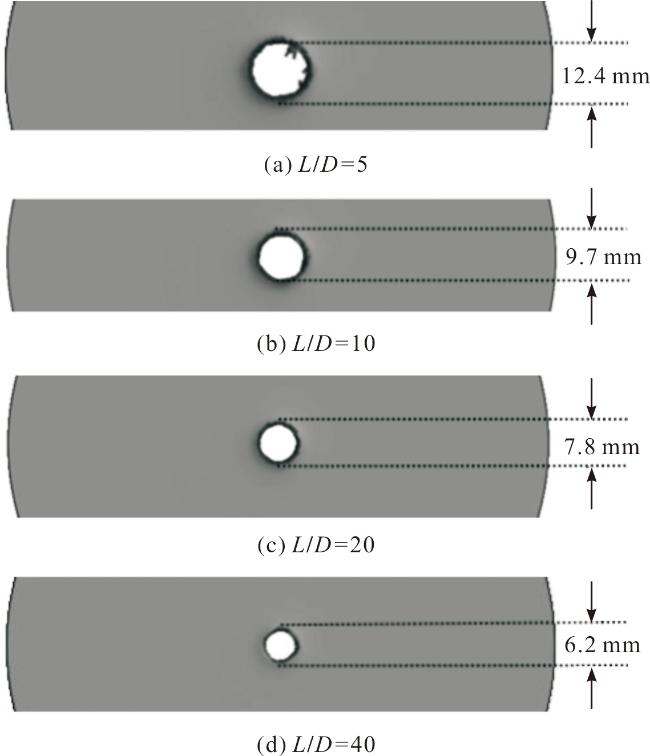
图3 靶板弹坑直径

Fig.3 Crater diameter of target plate

不同长径比的弹丸形成弹坑直径差距较大,而相同长径比,不同速度下的弹坑直径十分接近,因此对靶板弹坑直径而言,弹丸的直径对靶板弹坑直径的影响要明显大于弹丸速度对靶板弹坑直径的影响。弹丸直径越大,弹坑直径越大,弹丸与靶板之间的接触面积也会越大,对弹丸阻力越大,弹丸速度降越快,如图4所示。
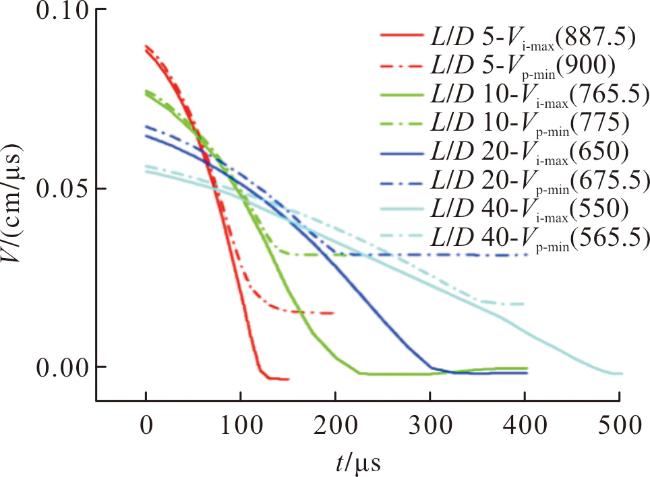
图4 速度-时间曲线

Fig.4 Curve of velocity-time

图4可以看出,随着长径比越大,速度-时间曲线斜率越小,长径比为5的弹丸,速度-时间曲线斜率最大,长径比为40的弹丸,速度-时间曲线斜率最小,且明显小于其他长径比弹丸的速度斜率曲线。
综上所述,随着弹丸长径比越大,侵彻靶板形成弹坑直径越小,弹靶接触面积越小,弹丸所受阻力越小,速度-时间曲线斜率也越小。与此同时,弹丸质量减少越慢,弹丸动能消耗越低,弹丸临界穿透速度也就越低。因此,对临界穿透速度而言,长径比越大,弹丸临界穿透速度越低,两者呈负相关联系。

2.2 靶板厚度对临界穿透速度的影响

选用弹丸长径比为10,弹丸直径为7.44 mm,弹靶材料不变,弹丸垂直侵彻靶板,靶板厚度DTar分别选为30 mm、35 mm、40 mm、45 mm,其余参数设置参考源参数设置。
将不同靶板厚度工况下得到的最大嵌入速度与最小贯穿速度绘制成表,如表3所示。
表3 靶板厚度工况表

Table 3 Working conditions of target plate thickness

Condition DTar/
mm
Vi-max/
(m/s)
Vp-min/
(m/s)
Vrem/
(m/s)
V50/
(m/s)
1 30 765.5 775 317 770.2
2 35 765.5 775 353 770.2
3 40 650 675.5 206 662.7
4 45 550 565.5 268 557.7
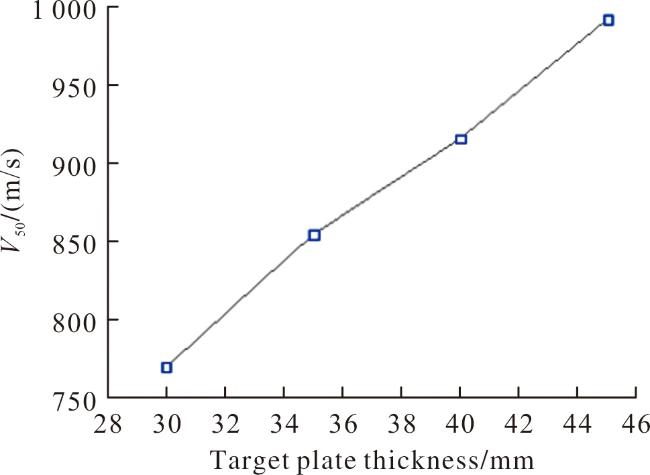
上述仿真所得临界穿透速度如图5所示。
图5 DTar-V50曲线

Fig.5 Curve of DTar-V50

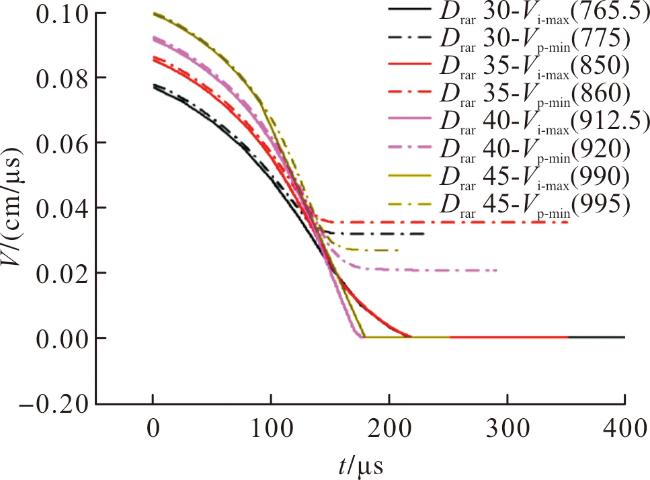
图5曲线分析可得,靶板厚度越大,弹丸临界穿透速度越大,两者呈现正相关联系。速度时间曲线如图6所示。
图6 速度-时间曲线

Fig.6 Curve of velocity-time

图6可以看出,靶板厚度越高,速度-时间曲线斜率越大,这是由于靶板越厚,在弹丸穿透靶板过程中,靶板吸收的弹丸动能越多,使其速度时间曲线下降越快,总体来说,靶板越厚,临界穿透速度越高。

2.3 弹丸着角对临界穿透速度的影响
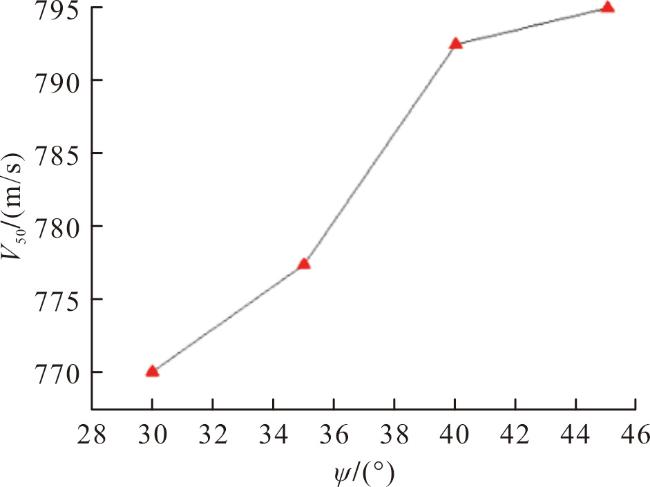
选用30 mm厚靶板,弹丸长径比10,弹丸直径为7.44 mm,着角ψ分别设置0°,5°,10°,15°,其余仿真参数保持源参数设置,不同着角对临界穿透速度的仿真结果如表4图7所示。
表4 着角工况表

Table 4 Striking angle condition table

Condition ψ/
(°)
Vi-max/
(m/s)
Vp-min/
(m/s)
Vrem/
(m/s)
V50/
(m/s)
1 0 765.5 775 317 770.2
2 5 775 780 126 777.5
3 10 790 795 181 792.5
4 15 790 800 58 795
图7 ψ-V50曲线

Fig.7 Curve of ψ-V50

将不同靶板厚度工况下得到的最大嵌入速度与最小贯穿速度绘制成表,如表4所示。
将上述仿真所得临界穿透速度绘制成图,如图7所示,随着着角ψ增大,临界穿透速度V50增加。
将上述各着角弹丸速度-时间曲线绘制成图,如图8所示。
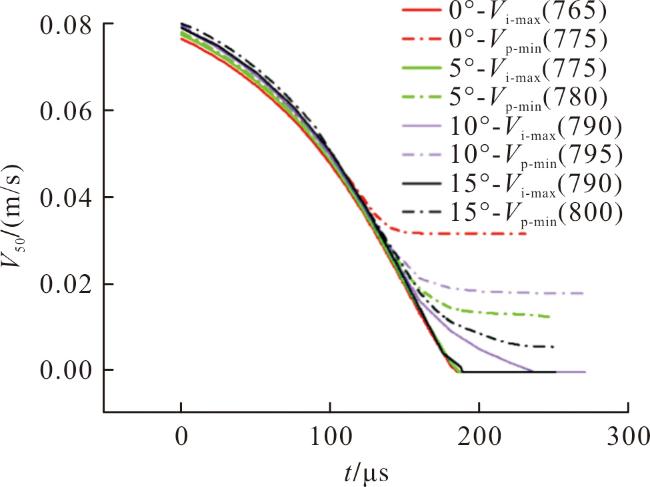
图8 临界穿透速度V50-时间曲线

Fig.8 Curve of V50-t

图8可知,随着着角ψ增大,临界穿透速度V50增大,但速度-时间曲线斜率相同,这可能是着角的增大只改变了临界穿透速度,而对速度-时间曲线没有影响;也可能是除着角外,其他因素对速度时间斜率也产生了影响,这些因素耦合作用下,抵消了着角因素对速度-时间曲线斜率的影响。
综上所述,着角ψ越大,临界穿透速度V50越高,两者呈正相关。

2.4 弹丸截面形状对临界穿透速度的影响

选用30 mm厚靶板,弹丸截面形状选用典型弹丸截面形状,分别选用圆形、正三角形、正方形以及十字形弹丸截面。
为保证截面形状对临界穿透速度的影响不受弹丸初始动能的干扰。即在相同的速度下,具有相同的初始动能,要保证不同截面形状的弹丸质量一致。同理,研究弹丸截面形状对临界穿透速度的影响,要确保弹丸的截面面积相同,因此,以圆形截面面积为基础,各弹丸截面面积相同均为43.5 mm2。各截面形状如图9所示。
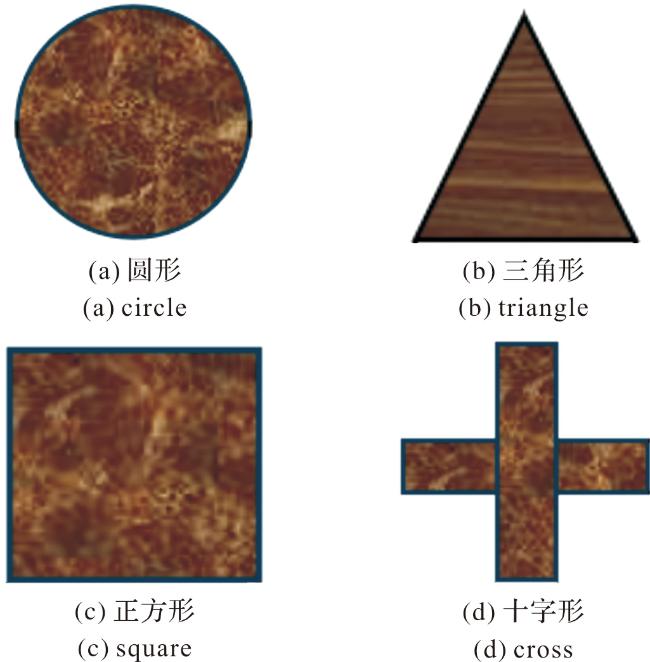
图9 截面形状

Fig.9 Cross-section shape

设各弹丸质量m相同,S为弹丸截面面积,则弹丸长度L=m/(ρS)。
将仿真所得临界穿透速度-时间曲线绘制成图,如图10所示。
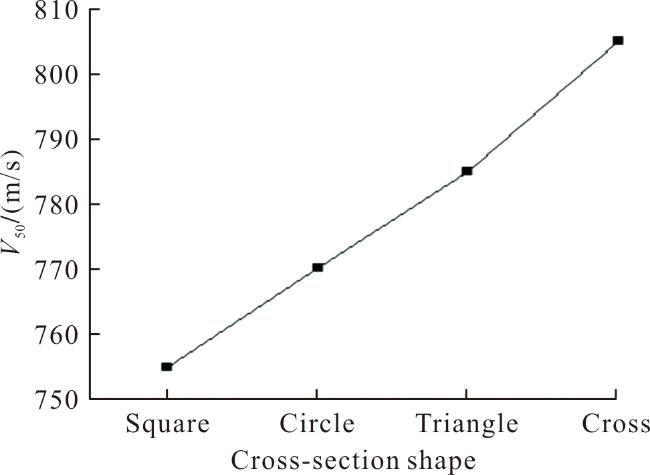
图10 截面形状-V50曲线

Fig.10 Curve of cross-section shape-V50

图10可知,在弹靶材料及其它因素不变情况下,不同弹丸截面形状会影响弹丸临界穿透速度,且影响程度排序为:正方形>圆形>三角形>十字形。
将上述各截面形状-速度曲线绘制成图,如图11所示。
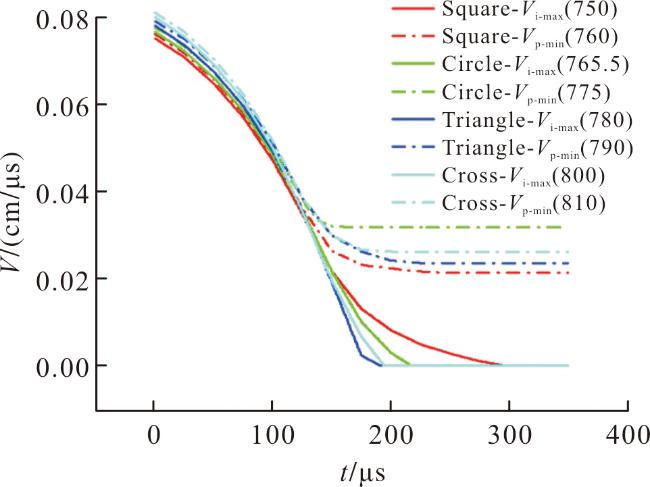
图11 不同截面形状时的速度-时间曲线

Fig.11 Curve of velocity-time at different cross-section shape

与着角因素所得速度-时间曲线相似,弹丸截面形状不同、所得临界穿透速度不同,但速度-时间曲线斜率相同,这是由于在弹丸侵彻靶板过程中,弹丸受到的阻力和动能损耗相同所导致。

3 正交优化设计

为了进一步探究临界穿透速度的主要影响因素,利用4×4正交优化表,参考上述仿真设置,重新进行16组因素排列组合的对应仿真,求得各组临界穿透速度。根据极差值匹配最佳因素组合,找到最低临界穿透速度,如表5所示。以K1~K4表示各因素在特定水平下的平均响应值;k1~k4表示4因素4水平下的平均响应值。计算各水平下的响应值和极差R,数据处理及结果如表6所示。
表5 正交优化表

Table 5 Orthogonal optimization table

Condition L/D DTar/mm ψ/(°) Cross-section
shape
V50/
(m/s)
1 5 30 0 Circle 893
2 5 35 5 Triangle 1 055
3 5 40 10 Square 1 165
4 5 45 15 Cross 1 325
5 10 30 5 Cross 777.5
6 10 35 0 Square 825
7 10 40 10 Triangle 965
8 10 45 15 Circle 1045
9 20 30 10 Triangle 685
10 20 35 15 Circle 755
11 20 40 0 Cross 805
12 20 45 5 Square 815
13 40 30 15 Square 560
14 40 35 10 Cross 635
15 40 40 5 Circle 655
16 40 45 0 Triangle 735
表6 数据处理及结果

Table 6 Data processing and results

Parameter L/D DTar/mm ψ/(°)
Sum of
different
factor
levels
K1 4 438 2 963 3 248
K2 3 670 3 280 3 350
K3 3 070 3 450 3 365
K4 2 575 3 920 3 705
Means of
the Sum of
different
factor levels
k1 1 109.5 740.75 812
k2 917.5 820 837.5
k3 767.5 862.5 841.25
k4 643.75 980 926.25
Range R 465.75 239.25 114.25

3.1 确定临界穿透速度影响因素的主次关系

通过表6R的大小判断各因素对临界穿透速度的影响大小,R越大,影响越大,可以得出各因素对临界穿透速度影响次序为:长径比>靶板厚度>着角>截面形状。

3.2 确定最佳组合
对临界穿透速度而言,速度越低,代表相同目标情况下,击穿目标所需动能越小,因此确定最佳组合即为确定最低临界穿透速度组合。
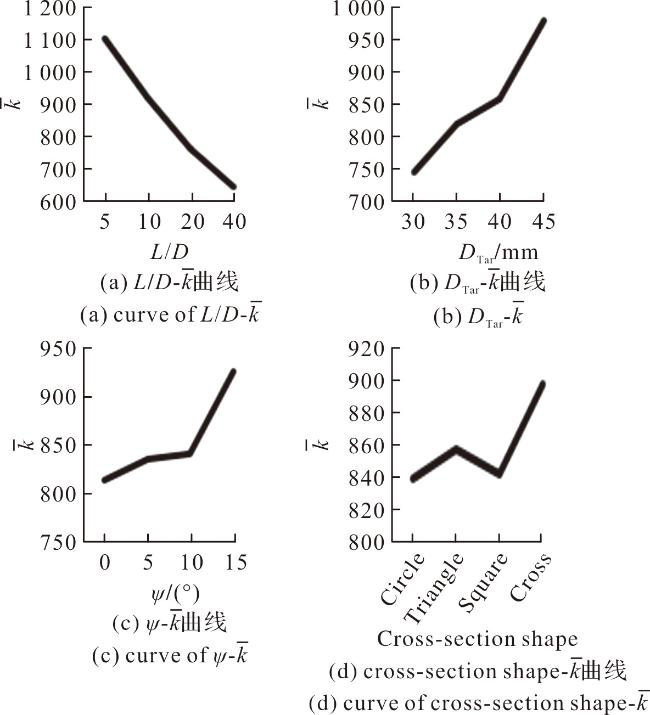
表5所述各因素范围与表6对应的k1~k4的均值 k ¯值如图12所示,选出 k ¯值最小组合即为临界穿透速度最佳组合。
图12 k ¯

Fig.12 Value of k ¯

图12可得,最佳组合为:长径比40、靶板厚度30 mm、着角0°、截面形状为正方形。
基于上述最佳组合方案进行仿真模拟,根据仿真结果得,最佳组合临界穿透速度为545 m/s。此时的临界穿透速度为最低临界穿透速度。

4 总结

文中通过数值仿真对钨合金长杆弹侵彻装甲钢的长径比、靶厚、着角、弹丸截面形状进行了单因素分析,并通过正交优化设计对上述4因素进行正交仿真,根据仿真结果分析影响临界穿透速度的主次关系,并确定最佳组合。结果表明:
1)长径比与临界穿透速度呈负相关,靶板厚度、着角与临界穿透速度呈正相关,截面形状对临界穿透速度也有显著影响;
2)钨合金长杆弹侵彻装甲钢的临界穿透速度影响因素大小排序依次为:长径比、靶板厚度、着角、弹丸截面形状;
3)基于各因素范围,最佳影响因素组合为长径比40、靶板厚度30 mm、着角0°、截面形状为正方形,此时的钨合金弹丸侵彻装甲钢最低临界穿透速度为545 m/s。
此外,利用正交优化设计,根据极差值判断主要影响因素,确定最佳组合方案计算最低弹丸临界穿透速度,为研究临界穿透速度提供一定的参考价值。
[1]
CHENG C, FU Y, DU C, et al. Experimental and numerical study of tantalum-tungsten alloy rod penetrator impacting thick armor plate[J]. International Journal of Refractory Metals and Hard Materials, 2022, 107: 105873.

[2]
李名锐, 冯娜, 蔡青山, 等. 93W杆式弹超高速撞击多层Q345钢靶毁伤及微观分析[J]. 爆炸与冲击, 2021, 41(2): 107-119.

LI M R, FENG N, CAI Q S, et al. Damage and microscopic analysis of 93W bar projectile by ultra-high speed impact on multi-layer Q345 steel target[J]. Explosion and Shock waves, 2021, 41(2): 107-119.

[3]
肖云凯, 吴昊, 方秦. 长杆弹超高速侵彻金属靶体的实验和模型分析[J]. 兵工学报, 2017, 38(S1): 15-23.

XIAO Y K, WU H, FANG Q. Experimental and model analysis of ultra-high speed penetration of long rod projectile into metal target[J]. Acta Armamentarii, 2017, 38(S1): 15-23.

[4]
MASRI R, DURBAN D. Ballistic limit predictions for perforation of aluminium armour plates by rigid nose-pointed projectiles[J]. International Journal of Impact Engineering, 2019, 131: 291-303.

[5]
孙欢腾. 杆式钨合金弹超高速撞击薄钢靶能量损耗模拟研究[D]. 湘潭: 湘潭大学, 2020.

SUN H T. Simulation study on energy loss of rod type tungsten alloy bullet impacting thin steel target at ultra-high speed[D]. Xiangtan: Xiangtan University, 2020.

[6]
王晓东, 王江波, 徐立志, 等. 异型截面长杆弹侵彻半无限厚金属靶板实验研究[J]. 爆炸与冲击, 2021, 41(3): 37-46.

WANG X D, WANG J B, XU L Z, et al. Experimental study on penetration of semi-infinite thickness metal target by long bar projectile with special section[J]. Explosion and Shock Waves, 2021, 41(3): 37-46.

[7]
杜成鑫. Wf/Zr基非晶复合材料杆弹准细观侵彻机理及优化设计[D]. 南京: 南京理工大学, 2022.

DU C X. Mechanism and optimal design of elastic microscopic penetration of Wf/Zr-based amorphous composite rod[D]. Nanjing: Nanjing University of Science and Technology, 2022.

[8]
李健, 王晓鸣, 赵国志. 长杆弹垂直侵彻有限厚靶着角对弹道极限速度影响的研究[J]. 兵工学报, 1995, 16(1): 23-27.

LI J, WANG X M, ZHAO G Z. Study on the influence of angle of attack on ballistic limit velocity of long bar projectile penetrating a finite thickness target[J]. Acta Armamentarii, 1995, 16(1): 23-27.

[9]
陈小伟. 穿甲/侵彻力学的理论建模与分析(上册)[M]. 北京: 科学出版社, 2019.

CHEN X W. Modelling on the perforation and penetration(Volume 1)[M]. Beijing: Science Press, 2019.

[10]
刘晓蕾, 王鹏, 谭争光, 等. 某弹丸45°着角下侵彻装甲钢板的极限速度研究[J]. 弹箭与制导学报, 2019, 39(3): 1-4.

DOI

LIU X L, WANG P, TAN Z G, et al. Study on the ultimate velocity of a projectile penetrating armor plate at 45° angle of attack[J]. Journal of Projectiles, Rockets, Missiles and Guidance, 2019, 39(3): 1-4.

[11]
RONG G, HUANG D W, YANG M C. Penetrating behaviors of Zr-based metallic glass composite rods reinforced by tungsten fibers[J]. Theoretical and Applied Fracture Mechanics, 2012, 58(1): 21-27.

[12]
LI J C, WEI Q, CHEN X W, et al. On the mechanism of deformation and failure in bulk metallic glasses[J]. Materials Science and Engineering: A, 2014, 610: 91-105.

[13]
LI J C, CHEN X W, HUANG F L. FEM analysis on the “self-sharpening” behavior of tungsten fiber/metallic glass matrix composite long rod[J]. International Journal of Impact Engineering, 2015, 86: 67-83.

[14]
王积锐, 王诚鑫, 王艺霓, 等. 长杆高速侵彻下装甲钢靶的等效强度[J]. 兵工学报, 2023, 44(12): 3755-3770.

DOI

WANG J R, WANG C X, WANG Y N, et al. Equivalent strength of armored steel target under high speed penetration with long rod[J]. Acta Armamentarii, 2023, 44(12): 3755-3770.

[15]
张清源. 长杆弹斜侵彻模型及仿真技术研究[D]. 长沙: 国防科技大学, 2023.

ZHANG Q Y. Research on oblique penetration model and simulation technology of long bar projectile[D]. Changsha: National University of Defense Technology, 2023.

[16]
戴喜会, 智小琦, 施兵, 等. 长径比及着靶姿态对钨柱极限穿透速度的影响[J]. 弹箭与制导学报, 2012, 32(6): 89-92.

DOI

DAI X H, ZHI X Q, SHI B, et al. Influence of length to diameter ratio and target attitude on the ultimate penetration velocity of tungsten column[J]. Journal of Projectiles, Rockets, Missiles and Guidance, 2012, 32(6): 89-92.

[17]
王奕鑫, 胡雪垚, 沈飞, 等. 靶板厚度对12.7 mm穿燃弹剩余速度和断裂特性的影响[J]. 弹道学报, 2024, 36(1): 57-62.

WANG Y X, HU X Y, SHEN F, et al. Effect of target plate thickness on residual velocity and fracture characteristics of 12.7 mm penetrating projectile[J]. Journal of Ballistic Science, 2024, 36(1): 57-62.

[18]
LIU Y B, YIN C F, HU X Y, et al. Ballistic limit velocity of tungsten alloy spherical fragment penetrating Ti/Al3 Ti-laminated composite target plates[J]. Advanced Composites Letters, 2020, 29: 1-6.

[19]
余庆波, 郭焕果, 张田育子, 等. 不同头形刚性弹丸侵彻钢靶力学行为[J]. 北京理工大学学报, 2017, 37(4): 331-336.

YU Q B, GUO H G, ZHANG T Y Z, et al. Mechanical behavior of penetrating steel target with different head rigidity projectiles[J]. Transactions of Beijing Institute of Technology, 2017, 37(4): 331-336.

[20]
王陆军. 钛合金在高速冲击下的抗撞击特性研究[D]. 天津: 中国民航大学, 2021.

WANG L J. Research on impact resistance of titanium alloy under high-speed impact[D]. Tianjin: Civil Aviation University of China, 2021.

[21]
LI J C, CHEN X W, HUANG F L. Ballistic performance of tungsten particle/metallic glass matrix composite long rod[J]. Defence Technology, 2019, 15(2): 132-145.

[22]
JOHNSON G R, COOK W H. A constitutive model and data for metals subjected to large strains, high strain rates and high temperatures[C]// Proceedings of the 7th International Symposium on Ballistics, ISB: Hague, 1983: 541-547.

[23]
Livermore Software Technology Corporation. LS-DYNA keyword user's manual[M]. Livermore: Livermore Software Technology Corporation, 2003.

Outlines

/