Numerical Simulation Study on the Anti-EFP Penetration Properties of B4C/Al Composite Targets

  • CUI Pingshun 1 ,
  • YIN Likui , 1, * ,
  • HUANG Junjie 2 ,
  • WANG Qibo 3 ,
  • AN Zhe 4 ,
  • HOU Xuhua 5
Expand
  • 1 School of Mechanical and Electrical Engineering, North University of China, Taiyuan 030051, Shanxi, China
  • 2 Target Damage Assessment Laboratory, Qianwei Technology Group Co., Ltd., Chongqing 401121, China
  • 3 Northwest Industries Group Co., Ltd., Xi'an 710043, Shaanxi, China
  • 4 Shandong Special Industry Group Co., Ltd., Zibo 255201, Shandong, China
  • 5 China Ordnance Industry Group Ammunition Research Institute Co., Ltd., Harbin 150036, Heilongjiang, China

Received date: 2025-09-30

  Online published: 2026-03-09

Abstract

To improve the resistance of B4C/Al composite targets against explosively-formed projectile (EFP) penetration, the surface morphology of ceramic strike face is modified. Seven types of B4C/Al composite targets featuring different protrusion-array structures on the strike face are examined. The processes of EFPs penetrating into the composite targets at 1.5, 1.7, and 1.9 km/s are simulated using LS-DYNA. The evolutions of the projectile's mass, velocity and kinetic energy during penetration are analyzed. The results indicate that B4C/Al composite targets with protruded strike-face structures exhibit superior penetration resistance and deceleration capability compared with B4C/Al flat-faced targets. Among them, the composite target with a pyramidal protrusion array provides the best deceleration performance for the simulated EFP.The R3 semi-cylindrical target demonstrates the best protective performance under normal impact. The penetration direction significantly affects the penetration resistance of anisotropic protrusion-array targets and the sinusoidal-structured target has the optimal protection performance under oblique impact.

Cite this article

CUI Pingshun , YIN Likui , HUANG Junjie , WANG Qibo , AN Zhe , HOU Xuhua . Numerical Simulation Study on the Anti-EFP Penetration Properties of B4C/Al Composite Targets[J]. Journal of Projectiles, Rockets, Missiles and Guidance, 2026 , 46(1) : 28 -36 . DOI: 10.15892/j.cnki.djzdxb.2026.01.004

0 引言

现代武器装备不仅需要安全、可靠的防护性能,也在不断追求轻量化。轻质装甲可提升机动性,增加有生力量和装备的战场生存能力。兼有高硬度和低密度特性的陶瓷作为制造装甲系统的理想材料,已广泛应用于人员、设备和工事的防护。
目前,国内外主要的防弹陶瓷有Al2O3、SiC、B4C、TiB2、Si3N4[1]。其中B4C陶瓷密度最低,硬度最高[2],是最理想的陶瓷轻质装甲材料。尽管B4C陶瓷制备昂贵,但在以轻量化为重要指标的空军防护系统中,B4C的优势无可替代。B4C/Al复合装甲已广泛运用于航空航天[3],在军用飞机防护领域有着极其重要的应用前景。
军机低空和超低空飞行时面临动能弹和EFP弹药(如反直升机地雷)的多重威胁。对陶瓷复合装甲抗弹丸侵彻能力及提升其防护性能的研究有重要意义。
在抗弹丸侵彻能力方面,王长利等[4]进行了EFP侵彻Al2O3、SiC、B4C装甲陶瓷的实验,表明B4C的抗侵彻性能最佳。李金柱等[5]进行了EFP侵彻陶瓷复合靶的数值模拟研究,结果表明选择合适的模型和参数,数值模拟结果可靠。武一丁[6]和傅国峰[7]分别研究了一定速度下B4C/Al复合靶对12.7mm穿甲弹和7.62mm穿甲弹的防护能力。
在防护性能提升方面,国内外主要从陶瓷材料性能、背板结构、界面设计三方面着手[8]。文献[9-16]研究了加工工艺对B4C/Al复合材料力学性能的影响。段卓平等[17]用EFP对Al2O3装甲陶瓷材料进行了侵彻实验,结果表明增加边界约束可以提高陶瓷的抗侵彻性能。Medvedovski[18]指出装甲迎弹面上附加的球形或球缺形陶瓷块能增强靶体对弹身的翻转,使弹体不能保持有利的侵彻姿态,从而提高装甲的抗弹性能。Monteiro等[19]的试验研究表明凸面陶瓷板比相同厚度的平面陶瓷板多耗散弹体16%-18%的能量。石益建等[20]试验验证了异形结构和包覆结构能提高陶瓷靶的防护性能。朱凌雪等[21]设计的锯齿波面陶瓷层结构在相当的防护能力下,质量降低了16.7%。另外,为提高抗多次打击能力,陶瓷复合装甲的陶瓷层常采用模块化拼接方式成型[22,23]
迄今为止,陶瓷复合装甲抗侵彻方面的研究侧重对穿甲枪弹,尚未见有复合装甲中陶瓷层表面形态对EFP抗侵彻能力影响方面的研究。因枪弹与EFP在质量、弹径和作用速度上均有显著差别,相关研究有待深化。本文针对陶瓷层迎弹面有7种不同形态的B4C/Al复合靶,使用LS-DYNA软件对EFP弹丸侵彻复合靶的过程进行数值模拟,对比不同B4C/Al复合靶对典型EFP的防护性能,为爆炸成形弹丸防护装甲的设计提供参考。

1 仿真模型

1.1 弹丸与靶板模型

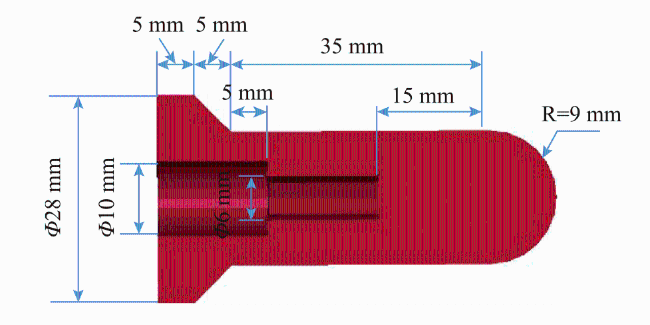
对聚能装药来说,加工精度及装配精度对其药型罩的成型影响显著。即使是同一批次生产的EFP聚能装药,最终形成的EFP难以完全相同;数值模拟由于忽略了部件加工和装配过程中的各种误差,再加上材料模型的表征误差,模拟结果与实际成型结果往往也有一定的差异。为提高研究效率并不失一般性,本文采用模拟EFP进行研究[5]图1给出了其几何尺寸[5],材料为紫铜,总质量124.4g。
图1 模拟EFP的结构尺寸图

Fig.1 Geometry of the simulated EFP

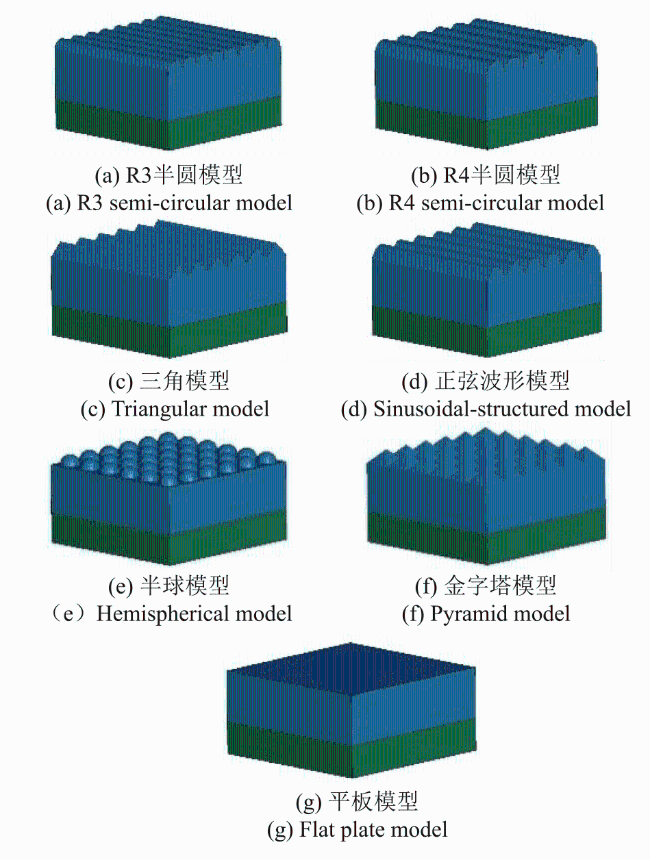
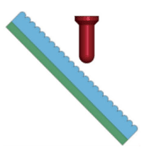
本文采用的B4C/Al复合靶结构(陶瓷板为面板,铝板为背板)见图2,其中a-c为沿用的石益建[20]提出的结构,d-f为本文提出的新结构,g中陶瓷板为平板的传统结构(简称为平板模型);图2a-f中陶瓷板表面有规则排列的凸起(下文统称为异形靶),对凸起形状,(a)为半径3mm的半圆柱阵列(简称为R3半圆模型);(b)为半径4mm的半圆柱阵列(简称为R4半圆模型);(c)为边长5.7mm的等腰三棱柱阵列(简称为三角模型);(d)为半周期8mm,峰值4mm的正弦柱阵列(简称为正弦波形模型);(e)为半径3mm的半球阵列(简称为半球模型);(f)为底边4mm,高4mm的金字塔阵列(简称为金字塔模型)。根据弹体特性参考文献[20]确定平板模型(见图2g)中陶瓷板的厚度为18.5mm,其它模型按等面密度原则确定相应厚度,铝合金板厚度均为8.7mm,面板尺寸为192mm×192mm。B4C/Al复合靶四周添加固定边界条件。
图2 复合靶局部有限元模型

Fig.2 Finite element model of composite target

另外根据靶板沿两个边长方向阵列特性的差异,将图2a-d 4种靶板称为阵列异性复合靶,将图2e-g 3种靶板称为阵列同性复合靶。

1.2 弹丸与复合靶材料模型

目前,Johnson-HolmquistⅡ(JH-2)模型[24]是应用最广泛的陶瓷材料本构模型,其表达式为:
σ'=(1-D)σ'i+Dσ'f
D=∑Δεp/ ε f p
p= K 1 + K 2 u 2 + K 3 u 3 , u 0 K 1 u , u < 0
式(1)~式(3)中:D为材料损伤参数,大小在0~1之间,σ'为损伤参数为D时材料无量纲Mises等效应力,σ'i为无初应力材料无量纲Mises等效应力,当材料未发生损伤(D=0)时,σ'i=A(p'+T')N·[1+Cln( ε   ·/ ε 0   ·)];σ'f为材料破坏无量纲Mises等效应力,材料完全破坏(D=1)时,σ'f=B(p')M·[1+Cln( ε   ·/ ε 0   ·)];ABCMN为拟合参数; ε   ·为动载荷下材料真应变率, ε   · 0为参考应变率;p'为无量纲压力,T'为无量纲最大负静水压力;p为材料所受静水压力;K1为材料体积模量,K2K3为状态方程参数;u为材料比容,u=ρ/ρ0-1,ρ为某一静水压下材料瞬时密度,ρ0为材料原始密度;σ'归一化为材料的Hugoniot等效屈服应力σHEL;p'归一化为材料的Hugoniot等效屈服压力pHELεp为单次循环内有效塑性应变积分; ε f p为一定压力下材料破碎塑性应变, ε f p=D1 ( p ' + T ' ) D 2,D1D2为材料损伤系数。
表1为本文B4C陶瓷的JH-2材料参数,取自文献[25]。
表1 B4C陶瓷JH-2材料参数

Table 1 Material parameters of B4C ceramic JH-2

参数 参数值 参数 参数值
ρ/(g/cm3) 2.51 ε 0   · 1.0×10-6
G/GPa 197 T/GPa 0.26
a 0.927 σHEL/GPa 19
b 0.7 pHEL/GPa 8.71
c 0.005 D1 0.001
m 0.85
n 0.67 D2 0.5
FS 1.6 K1 233
在弹丸对靶板高速侵彻过程中,弹、靶相互作用出现明显的应变率硬化效应和温度软化效应,并伴随靶体材料的塑性大变形和断裂。故涉及的EFP材料紫铜和背板材料105铝的材料模型均采用Johnson-Cook模型[26]来描述其在高温、高应变率情况下变形失效行为。表2给出其模型参数。
表2 紫铜和105铝的Johnson-Cook模型参数

Table 2 Johnson-Cook model parameters for copper and 105 aluminum

材料 紫铜 105铝 材料 紫铜 105铝
ρ/(g/cm3) 8.96 2.77 Tm/K 1356 775
E/GPa 14 69 Tr/K 300.15 294
v 0.33 0.33 D1 4.0 1.0
A/MPa 90 265 D2
B/MPa 292 426 D3
m 1.09 1.00 D4
n 0.31 0.34 D5
C 0.025 0.015

2 仿真结果与分析

2.1 EFP正侵彻分析

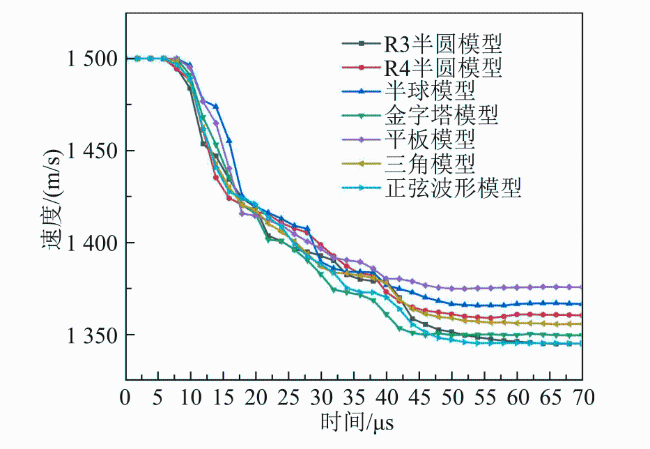
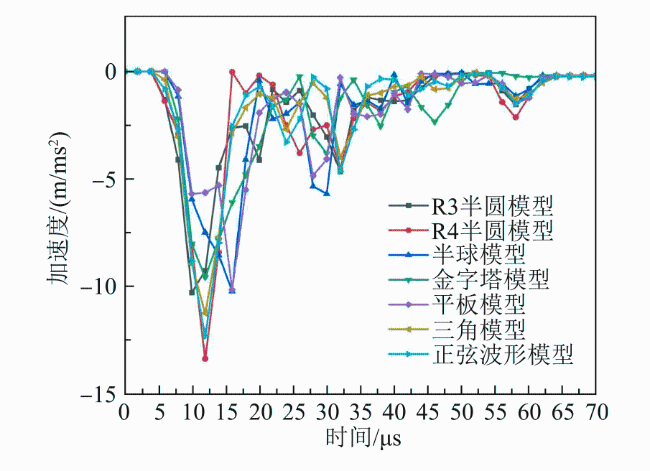
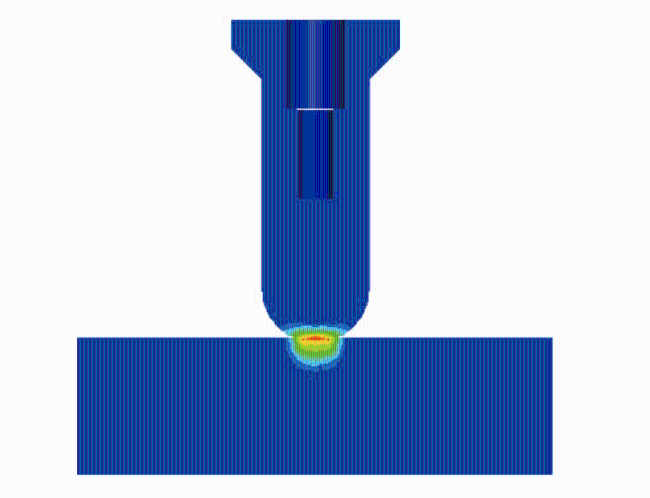
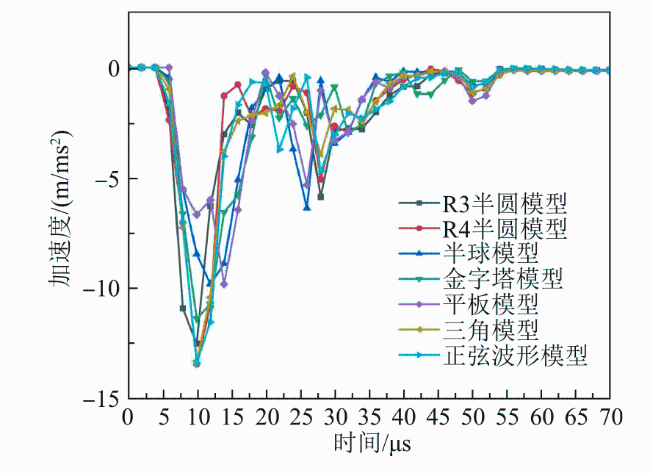
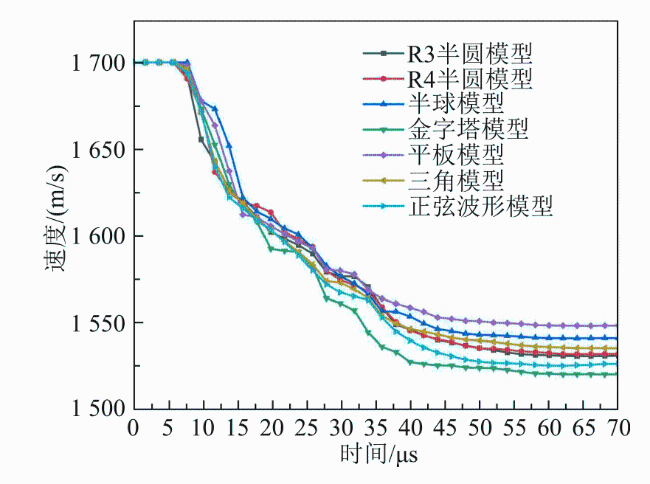
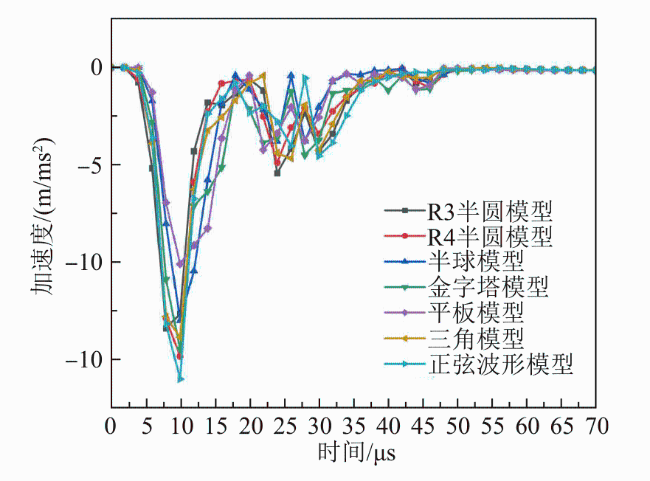
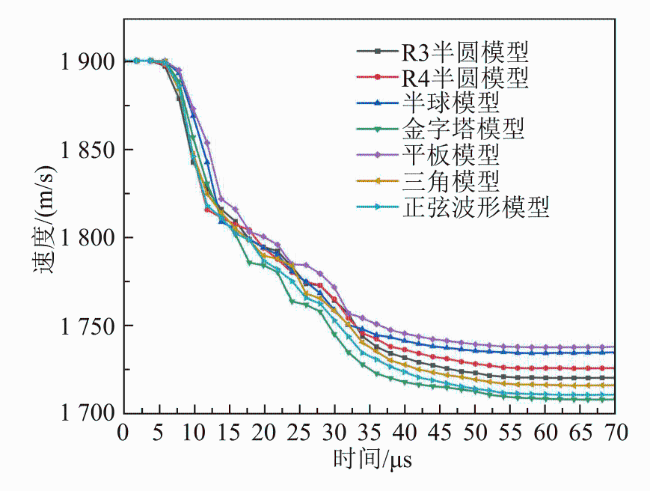
EFP以1.5km/s着速侵彻不同靶板的速度和加速度变化分别如图3图4所示。弹丸侵彻平板模型在约10μs时出现加速度的第一个峰值。此时段EFP头部变形但未侵入陶瓷靶(见图5)。
图3 弹丸侵彻不同靶板的速度变化(着速1.5km/s)

Fig.3 Variation of velocity of projectile penetrating different target plates at a velocity of 1.5km/s

图4 弹丸侵彻不同靶板的加速度变化(着速1.5km/s)

Fig.4 Variation of acceleration of projectile penetrating different target plates at a velocity of 1.5km/s

图5 弹丸侵彻平板模型10μs时的塑性形变(着速1.5km/s)

Fig.5 Plastic deformation of a projectile penetrating a flat plate model at a velocity of 1.5km/s for 10μs

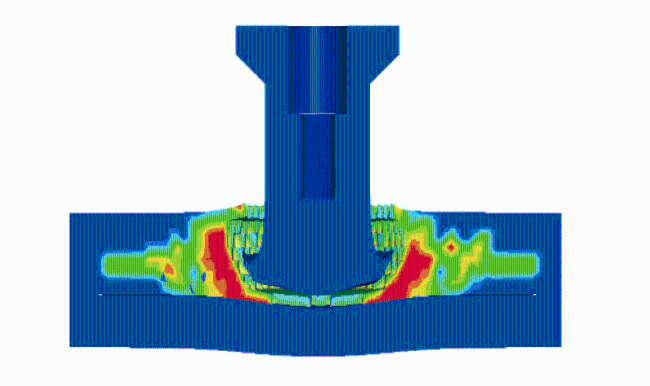
在陶瓷锥形成阶段(12~22μs),陶瓷在背板弯曲变形处承受拉应力,进而形成轴向裂纹。裂纹沿着陶瓷厚度和陶瓷与背板接触面环形传播,并最终在22μs碎裂成陶瓷锥形(见图6)。弹丸受的阻力也随着裂纹传播逐渐减小,与图4平板模型弹丸加速度逐渐减小相吻合。接着弹丸侵彻陶瓷碎片,在此过程铝背板发生弯曲变形和塑性硬化,弹丸加速度再次变大。由于EFP尾裙直径大于弹身,在28μs时尾裙部分接触靶板,受到的陶瓷靶板的阻力又变大,尾裙穿透靶板后,弹丸不再受阻力。这与图4弹丸加速度出现第二个峰值,之后缓慢减小相吻合。
图6 弹丸侵彻平板模型的陶瓷锥(着速1.5km/s)

Fig.6 The penetration of projectile into the ceramic cone of flat plate model at a speed of 1.5km/s

弹丸侵彻其他6种B4C/Al复合靶时,在16~35μs时间范围内,弹丸侵彻异形陶瓷靶的最大加速度均比平板模型大。
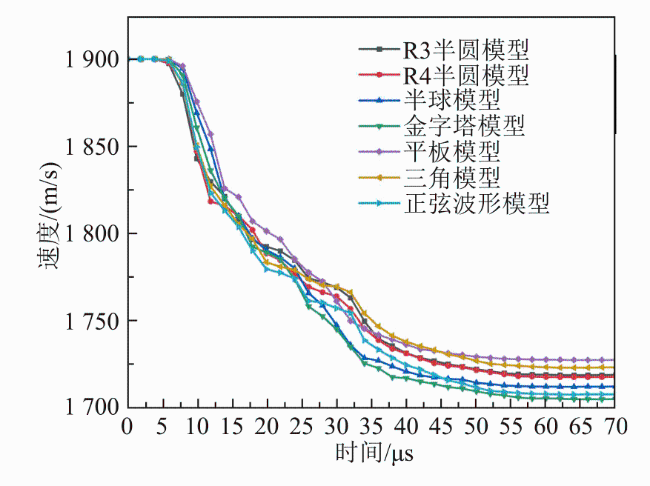
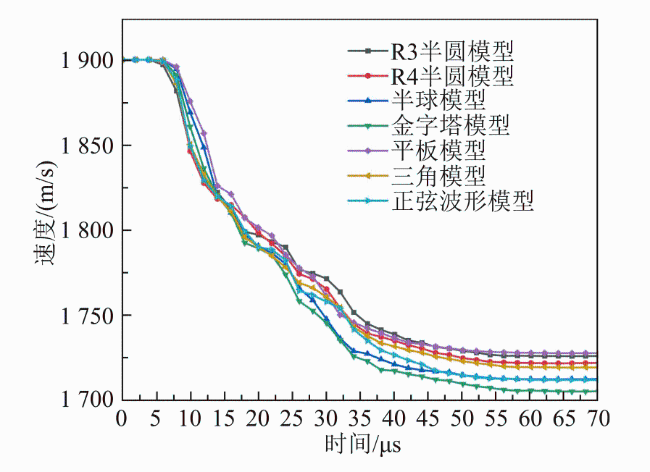
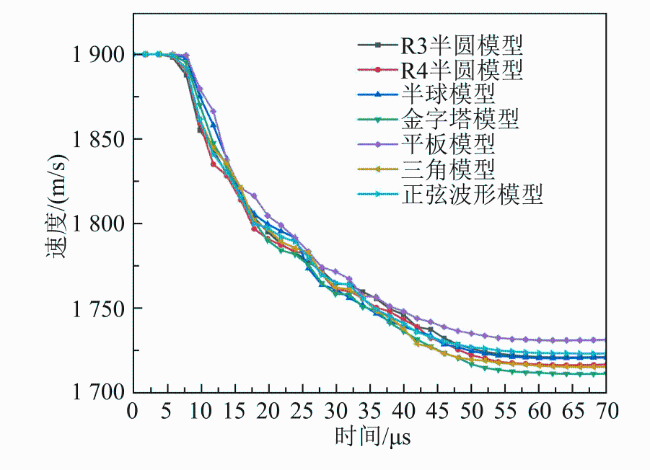
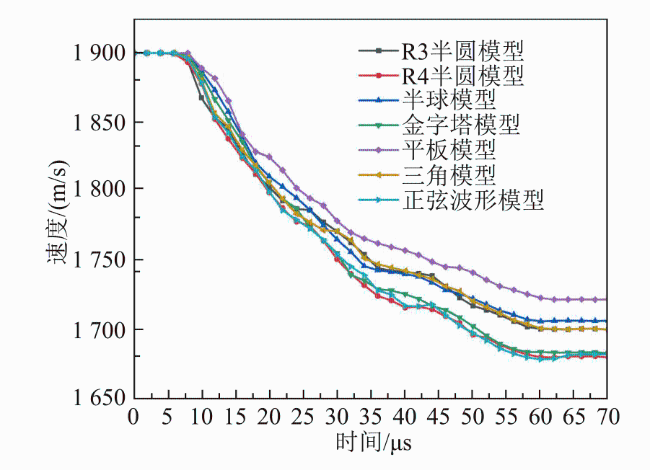
另外开展了EFP以着速1.7和1.9km/s侵彻B4C/Al复合靶的两组仿真。图7图9给出侵彻过程中EFP加速度变化,图8图10给出了速度变化。
图7 弹丸侵彻不同靶板的加速度变化(着速1.7km/s)

Fig.7 Variation of acceleration of projectile penetrating different target plates at a velocity of 1.7km/s

图8 弹丸侵彻不同靶板的速度变化(着速1.7km/s)

Fig.8 Variation of velocity of rojectile penetrating different target plates at a velocity of 1.7km/s

图9 弹丸侵彻不同靶板的加速度变化(着速1.9km/s)

Fig.9 Variation of acceleration of projectile penetrating different target plates at a velocity of 1.9km/s

图10 弹丸侵彻不同靶板的速度变化(着速1.9km/s)

Fig.10 Variation of velocity of projectile penetrating different target plates at a velocity of 1.9km/s

EFP弹丸正侵彻穿过各工况B4C/Al复合靶的速度变化见图3图8图10。异形复合靶相较于平板复合靶均能提高降低侵彻体速度的性能。侵彻金字塔模型的余速在1.7和1.9km/s工况下最低,在1.5km/s工况下次低,可见在金字塔模型降低EFP侵彻体速度的能力最强。
表3给出EFP弹丸正侵彻穿透各工况B4C/Al复合靶的质量损失率和动能损失率。可见EFP各工况下侵彻R3半圆模型的动能损失率最高,侵彻正弦波形模型的动能损失率次之。EFP的初速为1.4~2km/s时,以动能损失衡量靶板防护性能,R3半圆模型防护效果最佳。另外可见异形复合靶的防护效果皆高于平板复合靶,且防护性能提高最多有6.76%。
表3 EFP靶后质量损失和动能损失

Table 3 EFP post-target mass loss and energy loss

速度/(km/s) 1.5 1.7 1.9 1.5 1.7 1.9
模型 质量损失/% 动能损失/%
R3半圆模型 32.38 33.35 35.27 45.57 45.94 46.89
R4半圆模型 29.76 32.78 34.49 42.18 45.33 45.90
半球模型 26.93 29.92 30.28 39.30 41.80 41.82
金字塔模型 29.62 31.61 34.12 42.98 45.22 46.71
平板模型 27.32 28.70 30.45 38.81 41.33 41.76
三角模型 30.65 32.44 34.55 43.30 44.83 46.56
正弦波形模型 29.71 33.80 34.68 43.43 46.56 47.00
由本节结果可见,金字塔模型降速性能较好;R3半圆模型的防护性能最好。

2.2 EFP斜侵彻分析

实战情况下,EFP正侵彻情况极少,需要考虑着角的影响。本部分赋予EFP着速1.9km/s,着角有15°、30°、45°三种;对4种阵列异性靶,分别考虑了如表4所示沿着和垂直凸起棱柱方向的侵彻工况(以着角45°,R4半圆模型为例),下文分别称为I型侵彻和T型侵彻。
表4 侵彻工况说明

Table 4 Instruction of penetration conditions

工况 正视图 左视图
I型侵彻
T型侵彻
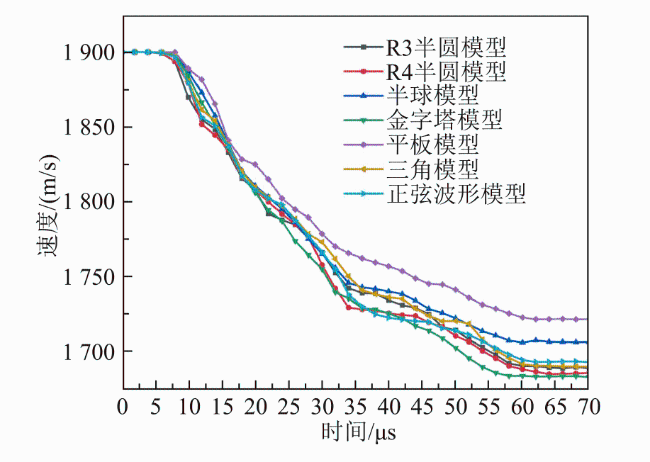
弹丸以15°着角侵彻复合靶(EFP余速变化见图11图12),I型侵彻梯度变化较为均匀,T型侵彻速度多分布于高速区。所得结论与正侵彻相同工况:异形复合靶的降速性能皆优于平板复合靶;侵彻金字塔模型的余速最低。
图11 15°着角时弹丸侵彻过程中速度变化(I型侵彻)

Fig.11 Variation of velocity of projectile penetrating different target plates at impact angle of 15°(Type I penetration)

图12 15°着角时弹丸侵彻过程中速度变化(T型侵彻)

Fig.12 Variation of velocity of projectile penetrating different target plates at impact angle of 15°(Type T penetration)

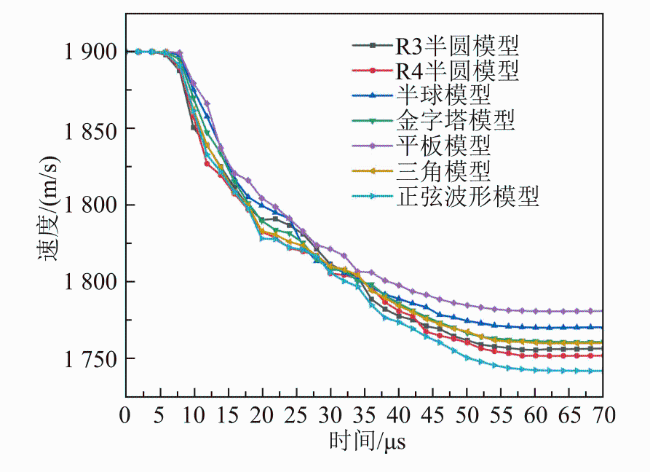
弹丸以30°着角侵彻复合靶(EFP余速变化见图13图14),异形复合靶的降速性能皆优于平板复合靶;图13图14中末速度的分布差异明显,图13中末速度相对分散,各异形靶板降速性能优劣明显,图14末速度相对集中,各异形靶板降速性能差异不明显,此现象证实着角30°时靶板对I型侵彻相较于T型侵彻更能发挥异形陶瓷的降速优势;着角30°I型侵彻时,正弦波形模型取代金字塔模型成为降速性能最优的模型。
图13 30°着角时弹丸侵彻过程中速度变化(I型侵彻)

Fig.13 Variation of velocity of projectile penetration different target plates at impact angle of 30°(Type I penetration)

图14 着角为30°时弹丸侵彻过程中速度变化(T型侵彻)

Fig.14 Variation of velocity of projectile penetrating different target plates at impact angle of 30°(Type T Penetration)

弹丸以45°着角侵彻复合靶(EFP余速变化见图15图16),异形复合靶的降速性能皆优于平板复合靶;I型侵彻与T型侵彻比较,EFP弹丸侵彻R3半圆模型和三角模型的末速度有所降低,其余相同,两种偏转方式优劣不明显;金字塔模型降速性能最优。
图15 着角为45°时弹丸侵彻过程中速度变化(I型侵彻)

Fig.15 Variation of velocity of projectile penetrating different target plates at impact angle of 45°(Type I penetration)

图16 着角为45°时弹丸侵彻过程中速度变化(T型侵彻)

Fig.16 Variation of velocity of projectile penetrating different target plates at impact angle of 45°(Type T Penetration)

对比各速度图像,T型侵彻在着角梯度上对复合靶的降速性能影响波动较大且相较于I型侵彻正面影响较小。着角越大,对异形复合靶降速性能的正面影响也越大。
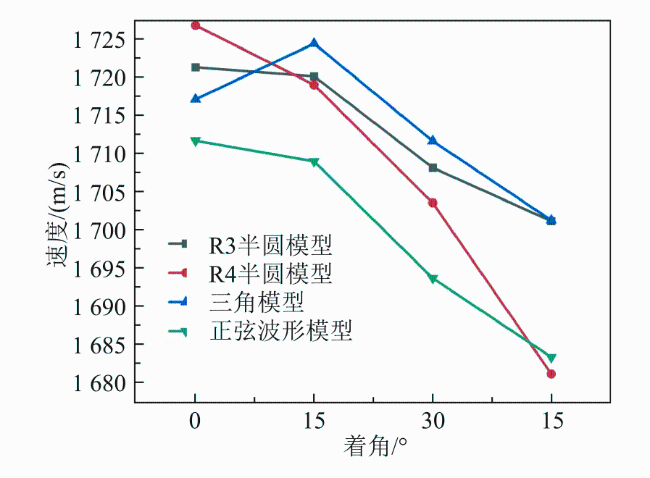
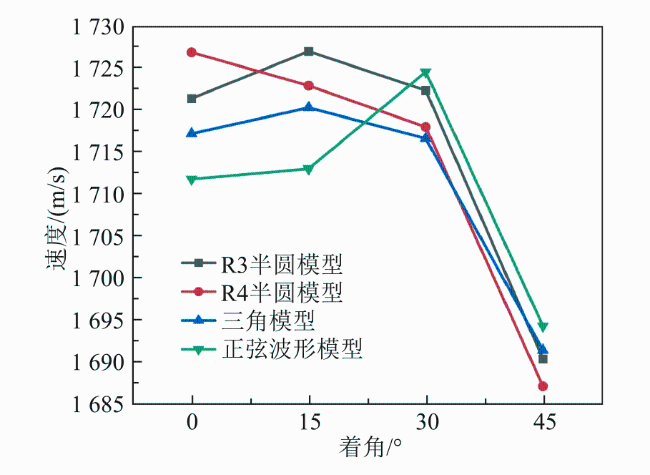
EFP弹丸存在着角(I型侵彻)侵彻阵列异性模型靶后存速变化见图17。侵彻三角模型在着角为30°时,出现靶后存速增大的现象;侵彻其余模型,靶后存速随着角增大而减小。
图17 I型侵彻对阵列异性模型EFP靶后存速随着角变化图

Fig.17 Plot of EFP post-target residual velocity as a function of impact angle (Type I penetration to anisotropic array model)

EFP弹丸存在着角(T型侵彻)侵彻阵列异性模型靶后存速变化见图18。侵彻R4半圆模型靶后存速随着角增大而减小;侵彻其余模型的靶后存速都变现为先增大后减小,侵彻正弦波形模型的图线变化最剧烈。
图18 T型侵彻对阵列异性模型EFP靶后存速随着角变化

Fig.18 Plot of EFP post-target residual velocity as a function of impact angle (Type T penetration to anisotropic array model)

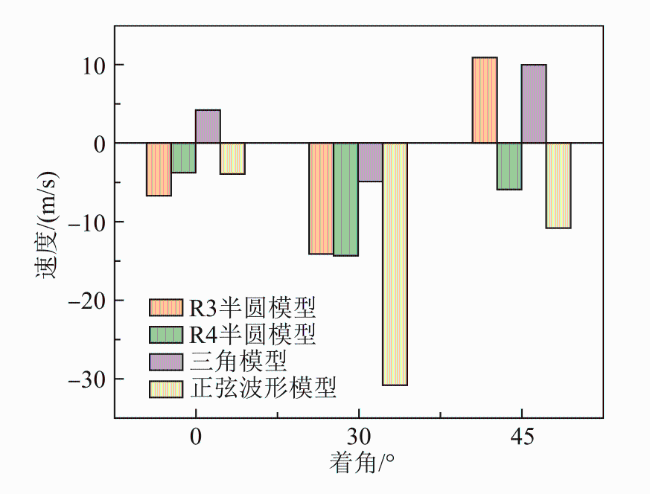
EFP弹丸有着角侵彻阵列异性模型两种方式(侵彻T型侵彻的靶后存速作为减数)的差速图见图19。柱状图中四分之三的柱体在y轴负半轴(且数据较大),可以得到结论I型侵彻阵列异性模型的平均靶后存速要小于侵彻T型侵彻的平均靶后存速。结合图17图18的靶后存速的变化趋势,可以得到结论,EFP弹丸有着角侵彻阵列异性靶时,靶板I型侵彻的方式相较于T型侵彻的方式提高了靶板的降速性能。
图19 两种侵彻方式EFP靶后存速差速图

Fig.19 Differential velocity maps of EFP post-target residual velocity under the two types of penetration modes

表5可见,I型侵彻的动能损失率除个别数据外,几乎全面高于T型侵彻,可见I型侵彻的防护性能更好。
表5 EFP侵彻阵列异性模型靶后质量损失和能量损

Table 5 Post-target mass loss and energy loss of EFP infiltration array anisotropy model

着角
模型 I型侵彻 T型侵彻 I型侵彻 T型侵彻
质量损失/% 动能损失/%
15 R3半圆模型 36.05 35.67 47.59 46.86
R4半圆模型 35.69 36.06 47.37 47.44
三角模型 36.29 35.08 47.53 46.79
正弦波形模型 36.84 35.50 48.91 47.58
半球模型 33.82 46.18
金字塔模型 34.51 47.20
平板模型 32.29 43.95
30 R3半圆模型 39.47 38.84 51.08 49.76
R4半圆模型 40.75 39.65 52.38 50.67
三角模型 38.85 38.18 50.38 49.55
正弦波形模型 41.31 37.96 53.38 48.91
半球模型 35.94 47.40
金字塔模型 38.03 49.00
平板模型 34.99 45.97
45 R3半圆模型 47.08 46.12 57.58 57.37
R4半圆模型 47.71 46.59 59.08 57.90
三角模型 46.21 45.71 56.88 56.99
正弦波形模型 47.61 45.49 58.89 56.67
半球模型 43.77 54.59
金字塔模型 45.67 57.32
平板模型 41.63 52.02
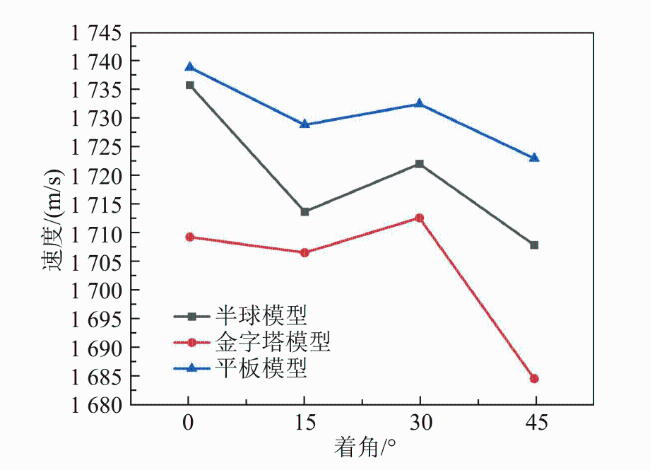
EFP弹丸存在着角侵彻阵列同性模型靶后存速变化见图20。侵彻三种模型的靶后速度在着角为30°时,同样出现了增大的现象,且侵彻相对防护性能越好的复合靶时波动也越大。
图20 EFP靶后存速随着角变化图(阵列同性模型)

Fig.20 Plot of EFP post-target residual velocity as a function of impact angle (isotropic array model)

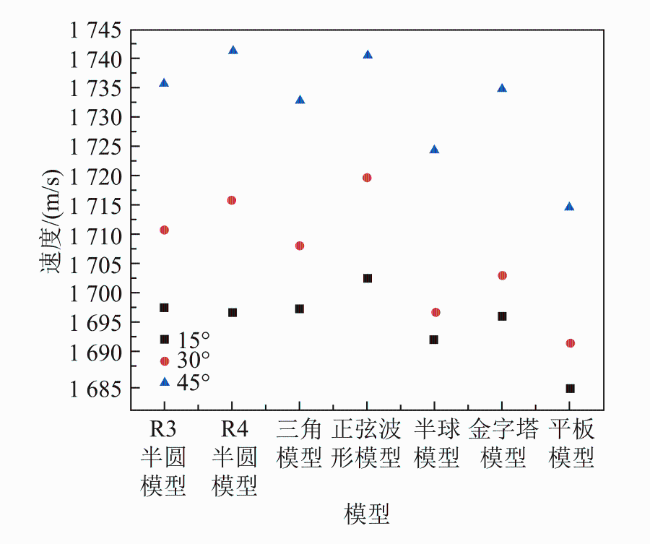
EFP弹丸斜侵彻穿过各工况B4C/Al复合靶的动能损失率的对比(阵列异性模型选择I型侵彻模型)见图21。可见侵彻正弦波形模型的动能损失率综合最高,以动能损失衡量,正弦波形模型防护性能最好。
图21 各工况下EFP斜侵彻穿透靶板的动能损失率

Fig.21 Kinetic energy loss rate of EFP obliquely penetrating through the target plate under each operating condition

由本节研究可见,金字塔模型降速性能较好;I型侵彻防护性能优于T型侵彻;正弦波形模型的防护性能最好。

3 结论

1)对弹丸在不同速度下正侵彻7种靶板,迎弹面R3半圆B4C/Al复合靶的抗侵彻较好,比平板模型对EFP动能有6.8%的能量损耗提升;金字塔模型降速性能优势明显,弹丸剩余速度最低,见图3图8图10
2)斜侵彻时,阵列异性模型I型侵彻动能损失相对较高,则其防护效果相对较好,阵列同性模型在着角为30°时,防护性能出现负波动;迎弹面正弦波形B4C/Al复合靶的抗侵彻较好,相比于平板模型有4.65%的能量损失提升;金字塔模型降速性能优势明显,见图11~图16,除个别图,弹丸侵彻金字塔模型余速均为最低。
[1]
孙志杰, 吴燕, 张佐光, 等. 防弹陶瓷的研究现状与发展趋势[J]. 宇航材料工艺, 2000, 30(5):10-14.

SUN Z J, WU Y, ZHANG Z G, et al. Research status and development trends of bulletproof ceramics[J]. Aerospace Materials &.Technology. 2000, 30(5):10-14.

[2]
郝焕. 防弹陶瓷材料的研究现状及发展趋势[J]. 中国陶瓷, 2023, 59(12):11-15.

HAO H. Research progress and development tren-ds of bulletproof ceramic materials[J]. China Ceramics, 2023, 59(12):11-15.

[3]
CHRISTMAN T, NEEDLEMAN A, SURESH S. An experi-mental and numerical study of deformation in metal-ceramiccomposites[J]. Acta Metallurgica, 1989, 37(11):3029-3050.

DOI

[4]
王长利, 周刚, 马坤, 等. 爆炸成型弹丸对陶瓷材料的侵彻实验研究[J]. 兵器材料科学与工程, 2017, 40(3):94-98.

WANG C L, ZHOU G, MA K, et al. Experimental study on penetration of explosively formed projectile into ceramic materials[J]. Ordnance Material Science and Engineering, 2017, 40(3):94-98.

[5]
李金柱, 黄风雷, 张连生. EFP模拟弹丸侵彻陶瓷复合靶的数值模拟研究[J]. 计算力学学报, 2009, 26(4):562-567.

LI J Z, HUANG F L, ZHANG L S. Numerical simulation of EFP projectile penetrating ceramic composite targets[J]. Chinese Journal of Computational Mechanics, 2009, 26(4):562-567.

[6]
武一丁, 高光发, 王晓东. 不同速度下B4C陶瓷/铝合金轻型复合靶板抗侵彻行为研究[J]. 南京理工大学学报, 2023, 47(4):503-513.

WU Y D, GAO G F, WANG X D. Research on the penetration resistance behavior of B4C ceramic/aluminum alloy lightweight composite target at different speeds[J]. Journal of Nanjing University of Science and Technology, 2023, 47(4):503-513.

[7]
傅国峰, 张鏖, 梅勇, 等. 不同结构B4C/Al复合材料抗侵彻性能研究[J]. 防护工程, 2024, 46(6):1-8.

FU G F, ZHANG A, MEl Y, et al. Research on penetration resistance of different structured B4C/AI composites[J]. Protective Engineering, 2024, 46 (6):1-8.

[8]
尹飞, 纪伟, 王智慧. 陶瓷复合装甲的研究现状及发展[J]. 兵器材料科学与工程, 2024, 47(1):106-111.

YIN F, JI W, WANG Z H. Research status and development of ceramic composite armor[J]. Ordnance Material Science and Engineering, 2024, 47(1): 106-111.

[9]
晁振龙, 姜龙涛, 魏嘉伟, 等. 基体合金对B4C/Al复合材料力学及抗弹性能的影响[J]. 兵器材料科学与工程, 2020, 43(1):6-10.

CHAO Z L, JIANG L T, WEI J W, et al. Influence of matrix alloy on mechanical and anti-ballistic properties of B4C/Al composites[J]. Ordnance Material Science and Engineering, 2020, 43(1):6-10.

[10]
GRUJICIC M, SNIPES J S, RAMASWAMI S. Ballistic impact behavior of nacre-like laminated composites consisting of B4C tablets and polyurea matrix[J]. Journal of Materials Engineering and Performance, 2016, 25(3):977-994.

DOI

[11]
王传薪. B4C增强铝基复合材料显微组织、力学性能的研究和有限元模拟[D]. 济南: 山东大学, 2016.

WANG C X. Microstructure,mechanical properties and finite element simulation of B4C-reinforced aluminum matrix composites[D]. Jinan: Shandong University, 2016.

[12]
石细桥, 柏兴旺, 俞雪奇, 等. B4C/Al复合材料的组织、力学性能和制备研究进展[J]. 机电工程技术, 2021, 50(3):76-78.

SHI X Q, BAI X W, YU X Q, et al. Research progress in microstructure,mechanical properties and preparation of B4C/Al composites[J]. Mechanical & Electrical Engineering Technology, 2021, 50(3): 76-78.

[13]
张柳. 层状B4C/Al复合材料的界面研究与高应变速率变形行为[D]. 济南: 济南大学, 2020.

ZHANG L. Interface study and high-strain-rate deformation behavior of layered B4C/Al composite[D]. Jinan: University of Jinan, 2020.

[14]
周圣杰. B4C/2024Al复合材料变形断裂行为研究[D]. 哈尔滨: 哈尔滨工业大学, 2020.

ZHOU S J. Deformation and fracture behavior of B4C/2024Al composites[D].Harbin: Harbin Institute of Technology, 2020.

[15]
王基峰. 碳化硼陶瓷的制备工艺探析[J]. 现代盐化工, 2021, 48(5):78-79.

WANG J F. Analysis of preparation process for boron carbide ceramics[J]. Modern Salt and Chemical Industry, 2021, 48(5):78-79.

[16]
刘薇, 杨军. 装甲防护材料的研究现状及发展趋势[J]. 热加工工艺, 2011, 40(2):108-111.

LIU W, YANG J. Research status and development trends of armor materials[J]. Hot Working Technology, 2011, 40(2):108-111.

[17]
段卓平, 朱艳丽, 张连生. 爆炸成型弹丸对Al2O3装甲陶瓷材料的侵彻实验研究[J]. 爆炸与冲击, 2006,(6):505-509.

DUAN Z P, ZHU Y L, ZHANG L S. DOP experimental study on EFP penetrating Al2O3 armor ceramic[J]. Explosion and Shock Waves, 2006,(6):505-509.

[18]
Medvedovski E. Ballistic performance of armour ceramics: Influence of design and structure.Parts 1 and 2[J]. Ceramics International, 2010, 36(7): 2103-2115 and 2117-2127.

DOI

[19]
Monteiro S N, Louro L H L, Gomes A V, et al. How effective is a convex Al2O3-Nb2O5 ceramic armor?[J]. Ceramics International, 2016, 42(6):7844-7847.

DOI

[20]
石益建. 轻质陶瓷纤维复合防弹结构设计研究[D]. 南京: 南京理工大学, 2019.

SHI Y J. Research on design of lightweight ceramic fiber composite bulletproof structures[D]. Nanjing: Nanjing University of Science and Technology, 2019.

[21]
朱凌雪, 朱凯, 刘杨, 等. 强化驻留效应的陶瓷复合装甲抗弹性能[J]. 南京工业大学学报(自然科学版), 2024, 46(2):188-197.

ZHU L X, ZHU K, LIU Y, et al. Ballistic performance of ceramic composite armor with enhanced dwell effect[J]. Journal of Nanjing Tech University (Natural Science Edition), 2024, 46(2): 188-197.

[22]
代春泉, 矫维成, 金浩正, 等. 拼接式陶瓷复合装甲的研究现状及发展趋势[J/OL]. 复合材料学报,2025:1-28.

DAI C Q, JIAO W C, JIN H Z, et al. Research status and development trends of spliced ceramic composite armor[J/OL]. Acta Materiae Compositae Sinica,2025:1-28.

[23]
赵春旭, 刘宇航, 刘亚洵, 等. 拓扑互锁陶瓷复合靶板的抗侵彻性能研究[J/OL]. 应用力学学报,2025:1-10.

ZHAO C X, LIU Y H, LIU Y X, et al. Anti-penetration performance of topologically interlocked ceramic composite targets[J/OL]. Chinese Journal of Applied Mechanics,2025:1-10.

[24]
JOHNSON G R, HOLMQUIST T J. An improved computational constitutive model for brittle materials[J]. AIP Conference Proceedings, 1994, 309(1):981-984.

[25]
JOHNSON G R, HOLMQUIST T J. Response of Boron car-bide subjected to large strains,high strain rates,and high pressures[J]. Journal of Applied Physics, 1999, 85(12):13-20.

[26]
JOHNSON G R, COOK W H. Fracture characteristics of three metals subjected to various strains,strain rates,temperatures and pressures[J]. Engineering Fracture Mechanics, 1985, 21(1):31-48.

DOI

Outlines

/